Architecture
Vrata has two components packaged in one binary. You choose the mode at startup.
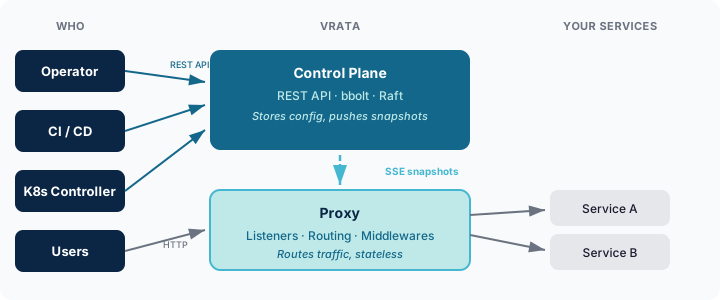
Control Plane
The control plane exposes the REST API, stores configuration in an embedded bbolt database, and pushes active snapshots to connected proxies via SSE (Server-Sent Events). It also serves the Swagger UI for API exploration.
mode: "controlplane"
controlPlane:
  address: ":8080"
  storePath: "/data"
The control plane is off the data path — it only pushes configuration. If it goes down, proxies keep routing with their last snapshot.
Proxy
The proxy is stateless. It connects to a control plane via SSE, receives configuration snapshots, builds a routing table, and routes traffic. Run 1 or 100 — they’re disposable.
mode: "proxy"
proxy:
  controlPlaneUrl: "http://control-plane:8080"
  reconnectInterval: "5s"
Each proxy opens its own listeners, applies middlewares, balances across destinations, and exposes Prometheus metrics — all driven by the snapshot it received.
HA Control Plane
For production, run 3-5 control plane nodes with embedded Raft consensus:
controlPlane:
  address: ":8080"
  storePath: "/data"
  raft:
    nodeId: "${POD_NAME}"
    bindAddress: ":7000"
    advertiseAddress: "${POD_IP}:7000"
    discovery:
      dns: "vrata-headless.vrata.svc.cluster.local"
Any node accepts reads and writes. Followers forward writes to the leader transparently. If the leader dies, Raft elects a new one. Proxies reconnect to any surviving node.
Clients
The REST API is the only interface. Anything that speaks HTTP can be a client:
- curl / scripts — manual operations
- Kubernetes Controller — watches Gateway API resources and syncs them to Vrata
- CI/CD pipelines — programmatic route management
- UI — planned